What is b-roll?
Simply put…
B-roll is the additional footage used to support your main footage – usually called A-roll.
Give me an example!
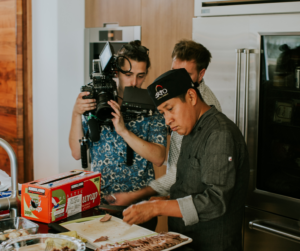
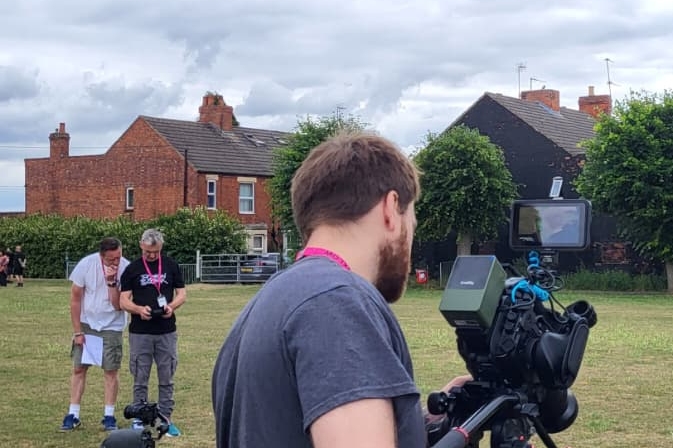
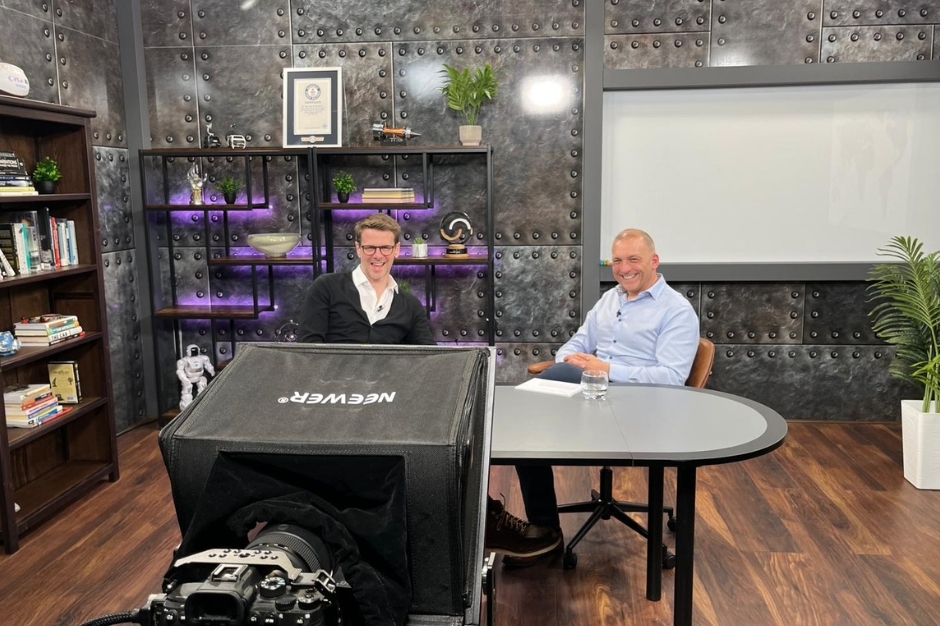
If someone is sitting in an interview talking about their business, the interview is your A-roll. Footage of their team working, products being made, customers using those products or the building they’re in is B-roll.
It can really add depth and context to your feature, whilst highlighting topics the interviewee is explaining.
5 reasons why B-roll matters
- It makes interviews more interesting
Nobody wants to stare at someone’s head for three minutes.
B-roll gives the viewer something visually relevant to look at while the person continues talking.
- It assists in storytelling
Instead of someone saying:
“Our team works incredibly hard to deliver every order.”
You can show the team working and that hits the audience harder.
- It helps to hide edits!
This is a big one that clients might not realise.
If someone says:
“We’ve been doing this for 20 years… and we’ve grown significantly…”
You might need to cut the interview to tighten it up.
Rather than showing an obvious jump cut, put B-roll over the edit.
- It keeps viewers engaged
Visual variety gives the audience a reason to keep watching.
Interview → factory → close-up → interview → customer → product → wide shot.
Much more dynamic.
- It gives you more content
One shoot doesn’t just give you the interview.
It gives a complex library to use again, and again – from the main film to product shots.
How much B-roll do you need?
Good question!
There’s no magic ratio, but when you’re filming an interview-led piece, you generally want far more supporting footage than you think you’ll need.
In our terms, if you think you’ve got enough B-roll, film some more!
Because once you’re editing, you’ll suddenly realise you need a 4-second shot of someone’s hands opening a door – and you didn’t film it. (Apologies to anyone who thinks we’re being extreme but trust us on this one!)
How do we approach B-roll at AR Media?
When we plan a video shoot, we don’t just think about the interview. We think about how we’re going to visually tell the story around it.
Before we arrive, we’ll consider the key messages, the locations, the people involved and the actions we need to capture.
That means we’re not simply collecting random footage. We’re building a library of shots that our in-house editors can use to make the finished film work.
A word from our editor
“From my perspective, B Roll is good for two things; firstly, if you can cut to a visual to demonstrate the subject in discussion then it’s a lot easier to understand as a viewer. Secondly, if there are areas for improvement or mistakes in the interview, then rather than shooting again you can utilise the B Roll to help pace the video more effectively. Essentially, cutting out the umm’s and arr’s and making it more shiny!” – Holly